New Highlights:
Vintage 2025: A Two-Harvest Year, the Marathon for Ripeness
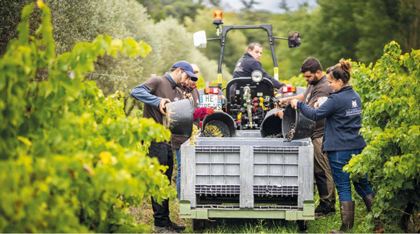
Between Climatic Contrasts and Human Expertise, a Vintage Both Tense and Promising. 2025 will be remembered as a year with two faces — a year of contrasts, adaptation, and extreme vigilance, where we had to double our observation and patience to turn climatic adversity into quality success.
Some estates benefited from a naturally favourable balance, while others had to cope with the extremes of a Mediterranean climate. In the end, the harvests were long, intense, and demanding: a true marathon of ripeness.
A Harvest Under Tension: Observe, Taste, Feel
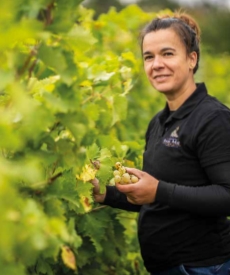
From the beginning of August, signs of low yields became clear. Under the combined effect of wind and heat, analytical maturity checks proved unusually unreliable: we physically had to be in the vineyards as often as possible each day, smelling, tasting, and observing the grapes to grasp their true maturity.
The only way to decide the right moment was to be there — row by row, grape by grape.
The harvest proceeded at a steady pace, often with the usual picking order disrupted: Grenaches sometimes preceded Syrahs, Mourvèdres overtook Carignans.
A Climate of Contrasts
The year 2025 put the vines to the test. After a rainy spring that replenished water reserves, the early summer heatwave caused ripening delays in several early grape varieties. Then, in mid-August, a new heatwave followed by scattered rains increased the risk of botrytis, demanding rapid responses. Finally, the end of summer alternated between cool winds, showers, and heat peaks — a typically Mediterranean sequence. Depending on soil type and vine age, we encountered all sorts of surprises in terms of yields, but consistently with high-quality grapes.
Languedoc: Fragile Yields and Superb Reds
In the Hérault, the harvest was early, marked by heat and drought. Yields fell by around 20% compared to 2024, notably due to two weeks of hot north wind drying the grapes. Cabernet Sauvignon yields were very low, between 3 and 5 tons per hectare. Sauvignon Blanc and Chardonnay suffered the heaviest losses.
Viognier retained its richness, while Grenaches and Syrahs offered harmonious balance, supported by high sugar levels and ripe aromatic profiles.
Les coteaux du Languedoc
Around Château des Crès Ricards, capricious weather tested nerves. Rain forecasts were often contradicted, making harvest planning complex. Syrahs and Merlots suffered from the August heat, but Grenaches benefited from early September rains.
Thanks to a young, responsive team, quality was preserved. Human effort made the difference in this contrasting vintage.
Roussillon
In the Roussillon, the harvest stretched from August 18 to September 26. The mid-August heatwave accelerated the white grape harvest, executed in only four days on reduced volumes. Despite this, 2025 surpasses 2024.
Reds ripened more slowly, achieving remarkable balance. Teams describe a stressful and formative year, where each and every small decision mattered.
L’Aude
In the Limoux region, cradle of sparkling wines, the harvest demanded absolute precision. Low yields and small Chardonnay clusters required meticulous winemaking.
The bases for sparkling wines stand out for their beautiful natural acidity, pure aromas, and freshness typical of high-altitude sites. This vintage confirms that in Limoux, more than anywhere else, precision in the vineyard makes the difference.
At Château Jérémie and Château Capendu, high heat slowed berry development, followed by two humid weeks that caused significant leaf stress. South- and west-facing plots were particularly affected, with sunburned areas. Yields remained very low in both IGP and AOP, notably at Capendu and Jérémie.
Domaine de la Ferrandière, near the Marseillette pond, fared better thanks to water availability. Techniques such as carbonic maceration were applied to some vats, improving several other cuvées, including *Y by Château Jérémie* (AOC Corbières).
Resistant grape varieties proved their value: Voltis Blanc showed good drought resistance, while Vidoc Rouge remained more fragile, with low yields. New plantings of Cabernet Blanc and Muscaris aim to strengthen vineyard resilience.
Despite reduced yields, 2025 stands out for better quality than 2024, especially for reds and La Ferrandière wines. Efforts in climate adaptation, varietal diversification, and vinification experimentation are already bearing fruit.
A Vintage of Character
The 2025 vintage exemplifies the complexity of Southern France: an extreme Mediterranean climate, fragile yields, but exemplary human and technical resilience.
Reds reveal power, consistency, and balanced tannins; whites shine with freshness and concentration; sparkling wines display refined elegance, the signature of high-altitude terroirs.
Beyond numbers and aromatic profiles, 2025 tells another story: a viticulture that adapts, sometimes doubts, but never yields. A tense, demanding, deeply human year, where every decision in the vineyard — observing, tasting, waiting, daring — carried more weight than ever.
Within this tension, there is a breath of hope.
Native, resilient varieties — Grenache, Carignan, Vermentino, Cinsault, Muscats, and Piquepoul — emerge as the natural guardians of tomorrow: rooted, strong, and loyal to their terroir. They prove that another South is possible: more restrained, more precise, yet still vibrant. Other varieties, such as Souvignier Gris, Petit Manseng, Roussanne, and Marselan, also play their part.
2025 is not just a difficult vintage; it marks the beginning of a new era for our Southern viticulture.